
The Hidden Mathematical Challenge of University Course Registration
Course registration is often described as a rite of passage, but in reality, it is a combinatorial puzzle. A university undergraduate attempting to schedule 5 courses from a catalog offering multiple section times, recitation periods, and laboratory blocks must navigate thousands of mathematical combinations. One conflicting section can trigger a cascading failure across your entire semester plan, forcing you into undesirable 8:00 AM slots or stranding you on campus with 3-hour dead gaps.
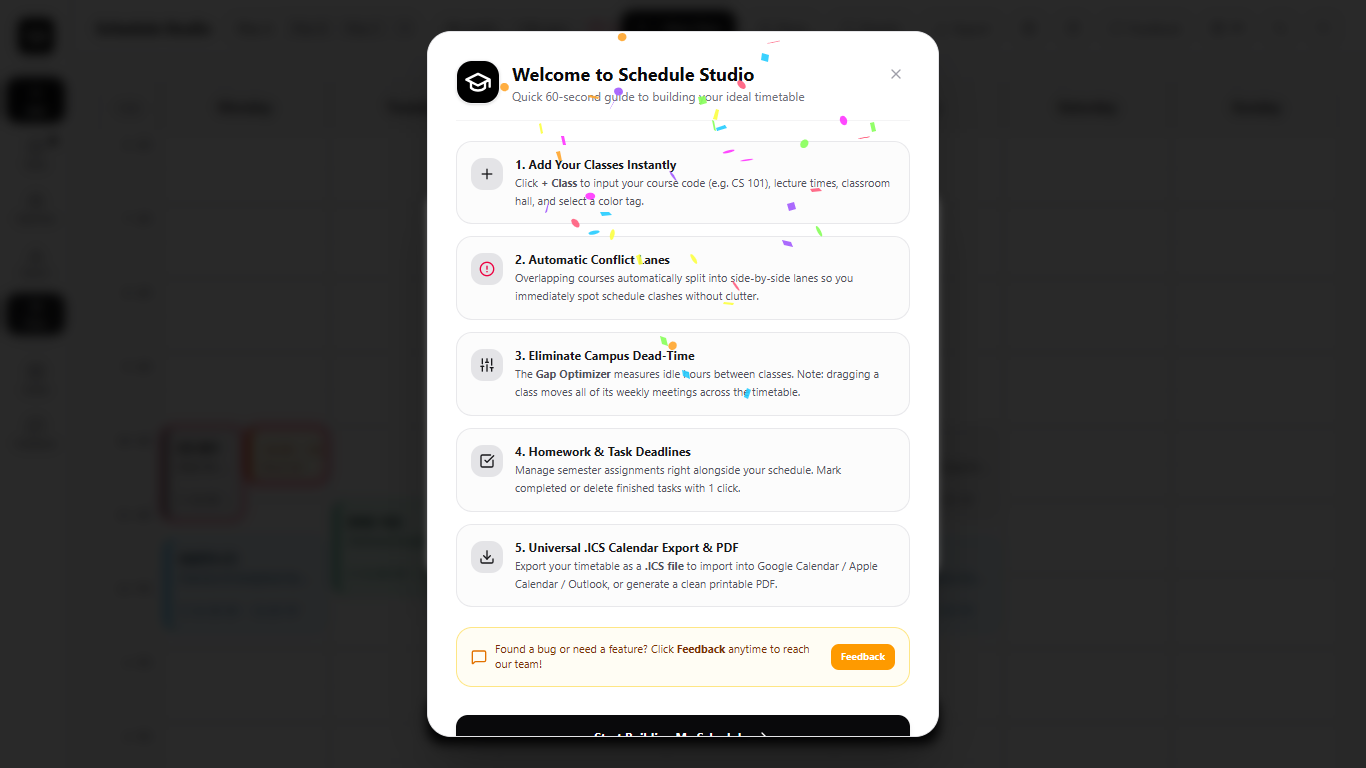
Our free college schedule maker was built to replace static paper scratchpads and clunky registrar interfaces with an agile, real-time visual environment. By dragging, dropping, and adjusting sections in an interactive 5-day grid, you can stress-test multiple scheduling hypotheses weeks before your enrollment appointment begins.
Five Core Rules for Building a Sustainable University Timetable
Respect Your Chronotype: The 8:00 AM Reality Check
In high school, waking up at 6:30 AM was non-negotiable. In college, managing your own sleep schedule and late-night study sessions drastically alters your cognitive alertness. Unless you are naturally an early-morning lark who consistently sleeps before 10:00 PM, avoid 8:00 AM lectures. Attendance records show that 8:00 AM classes suffer 35% higher absenteeism and lower average exam scores compared to 10:00 AM or 11:00 AM sections.
Calculate Geographic Walking Buffers Between Campus Buildings
Registrar software only checks whether class minutes overlap on the clock; it never checks if human bodies can traverse physical campus topography. If your Chemistry lecture ends in the science quad at 10:50 AM and your Economics seminar starts at 11:00 AM on the opposite side of campus, a 10-minute passing window is a recipe for chronic tardiness and elevated cortisol. Use our tool's building tag fields to verify reasonable transit buffers.
The 2:1 Study-Hour Rule for Credit Load Calibration
Higher education accreditation boards formulate credit hours based on the standard ratio: for every 1 credit hour spent in class per week, expect 2 to 3 hours of independent reading, problem sets, and revision. A 15-credit schedule implies 15 contact hours plus 30 hours of homework—amounting to a full-time 45-hour work week. Don't overload 18 or 20 credits unless your extracurricular commitments are minimal.
Consolidate Dead Gaps Into Actionable Study Blocks
A 45-minute gap between classes is cognitive dead time: too short to walk back to your dorm or start a deep research paper, yet long enough to drain mental energy scrolling on your phone. Contrast that with a consolidated 3-hour afternoon block where you can complete an entire weekly lab report in the library. Our Schedule Studio tracks total idle hours in real time to help you compress your day.
Prepare Primary and Fallback CRN Contingency Trees
Never enter registration day with only one ideal timetable. When high-demand prerequisites fill up in seconds, panicked students make rash decisions that ruin their semester balance. In Schedule Studio, build your Plan A, then toggle alternative section times to create Plan B and Plan C. Keep backup 5-digit Course Reference Numbers (CRNs) copied to your clipboard.
Sample Undergraduate Timetable: 15-Credit Balanced Blueprint
Here is an example of an expertly engineered semester timetable balancing general education requirements, major coursework, and a STEM laboratory:
| Course Code | Course Title | Credits | Days | Time Slot |
|---|---|---|---|---|
| CS 101 | Intro to Computer Science | 4.0 | MWF | 10:00 AM – 10:50 AM |
| MATH 141 | Calculus I | 4.0 | MWF | 11:15 AM – 12:20 PM |
| PHYS 201 | General Physics I | 3.0 | TTh | 09:30 AM – 10:45 AM |
| PHYS 201L | Physics Laboratory | 1.0 | Thu | 01:30 PM – 04:20 PM |
| ENG 102 | Academic Writing & Rhetoric | 3.0 | TTh | 11:15 AM – 12:30 PM |
| Total Term Academic Load | 15.0 Credits | Zero Conflict Split-Lanes | ||
Synchronizing Your Academic Timetable with Real-World Calendars
To synchronize your college class schedule with real-world calendar apps, export your finalized weekly timetable from Schedule Studio as a universal iCalendar (.ICS) file, then import it into Google Calendar, Apple Calendar, or Microsoft Outlook. The calendar software automatically creates weekly recurring class events for all 15 semester weeks, complete with classroom building tags and departure notifications.
Our Schedule Studio generates clean, universal .ics (iCalendar) exports formatted specifically for Google Calendar, Apple iCal, and Outlook. With one click, your entire 15-week class sequence is populated with recurring event rules, classroom locations, and 15-minute departure alarms. For more tips on calendar workflows, read our detailed guide on How to Add Your Class Schedule to Google Calendar.