
First-Semester Freshman Schedule: A Simple Guide
Build your first-semester college freshman schedule. Avoid the 8 AM trap, balance general education electives, and transition smoothly to university life.
First-Semester Freshman Schedule: A Simple Guide
Transitioning from high school to university is one of the most exciting milestones of your young adult life. For twelve years, your daily schedule was dictated down to the minute: yellow buses at 7:15 AM, seven back-to-back bell periods, monitored 30-minute cafeteria lunches, and dismissal at 3:00 PM.
Suddenly, you arrive at college orientation, and an academic advisor hands you a course catalog with hundreds of unfamiliar terms, credit hours, and meeting times, saying: “Pick 15 credits.”
The autonomy is liberating, but it is also dangerous. Incoming freshmen frequently make predictable, avoidable scheduling mistakes during their first semester—mistakes that lead to sleep deprivation, missed classes, and disappointing first-term grades.
In this operational guide, we walk you through the essential rules of architecting a successful first-semester freshman timetable using our free College Schedule Maker.
1. The Top Three Traps That Destroy Freshman Schedules
Trap 1: The “I Woke Up at 6:00 AM in High School, So 8:00 AM Classes Are Easy” Illusion
This is the single most common mistake made by incoming college freshmen.
In high school, waking up at 6:00 AM was manageable because your parents reinforced bedtime boundaries, you had zero control over your daily routine, and campus dorm life did not exist.
In a college dormitory, your roommates stay up until 1:00 AM debating philosophy, campus social activities run late into the evening, and no parent knocks on your bedroom door to ensure you are awake. Data across university registrar offices demonstrates that 8:00 AM courses suffer from 30% to 40% higher absenteeism among first-year students than identical courses held at 10:00 AM or 11:00 AM.
Rule: Unless an 8:00 AM section is the only prerequisite available for your major, set your earliest class time to 9:30 AM or 10:00 AM.
Trap 2: The Marathon “Back-to-Back” Day
Some freshmen look at a weekly calendar and think: “If I schedule four classes back-to-back on Monday and Wednesday from 9:00 AM to 3:00 PM, I can get all my schoolwork over with early!”
In high school, you sat through back-to-back classes because secondary teachers frequently allocate class time for homework, review games, and group worksheets. In a collegiate university lecture, professors deliver dense, high-velocity conceptual material for 50 to 75 unbroken minutes.
Sitting through three consecutive college lectures is mentally exhausting. By your third lecture, cognitive retention plummets, your note-taking becomes sloppy, and you have zero time between classes to grab lunch, use the restroom, or review notes.
Rule: Never schedule more than two consecutive lectures without an intentional 45-to-60 minute nutritional and cognitive buffer.
Trap 3: The “All-Major” Heavyweight Load
Eager freshmen often attempt to prove themselves by registering exclusively for difficult major prerequisites in their first term: Calculus I, General Chemistry, Physics, and Intro to Computer Science.
While well-intentioned, an all-STEM semester combines three complex weekly problem sets with two multi-hour laboratory reports. If you struggle in one course, the overwhelming workload causes a downward spiral across all four subjects.
Rule: Practice the 3 + 1 + 1 Formula.
2. The Ideal Freshman Formula: The 3 + 1 + 1 Rule
To ensure academic momentum while preserving mental well-being, design your 14-to-15 credit first-semester timetable around the 3 + 1 + 1 Rule:
| Component | Course Type | Purpose & Description |
|---|---|---|
| 3 Courses | Core Degree Prerequisites | Two foundational major courses (e.g., Intro to Psychology and College Algebra) plus your mandatory First-Year Writing / English Composition seminar. |
| 1 Course | General Education Elective | A broad humanities, social science, or artistic breadth requirement (e.g., Intro to Sociology, Philosophy of Ethics, or Film History). |
| 1 Course | Freshman Seminar / Exploration | A 1-to-2 credit university transition course or a genuine interest exploration course that broadens your perspective with manageable grading. |
This formula guarantees that you make steady progress toward your degree requirements while ensuring your weekly homework load is balanced across diverse cognitive modes (mathematical problem sets balanced by reading and essay reflection).
3. Walking Distances & Campus Geography
In high school, passing from English to Chemistry took ninety seconds down a carpeted hallway. At a major university, campus grounds often span hundreds of acres.
Before registering for classes:
- Pull up your campus map: Identify the exact buildings where your lectures and recitations meet.
- Measure walking times: Registrar systems allow 10 to 15-minute passing windows between periods. If your biology lecture ends at 10:50 AM on South Campus and your philosophy discussion starts at 11:00 AM on North Campus, an 800-meter sprint across campus with a 20-pound backpack will make you chronically late.
- Use Schedule Studio Location Tags: In Schedule Studio, type your building codes (e.g.,
Smith Hall 102) directly into the room field so you can spot physically impossible building transitions before registration begins.
4. Sample First-Semester Freshman Schedule (15 Credits)
Here is a blueprint of an expertly balanced first-semester undergraduate schedule:
-
Monday / Wednesday / Friday (MWF):
10:00 AM – 10:50 AM: ENG 101: Academic Writing (Core Requirement)11:15 AM – 12:05 PM: MATH 115: Pre-Calculus (Major Prerequisite)12:05 PM – 01:15 PM: Lunch Break & Library Review01:30 PM – 02:20 PM: PSYC 101: General Psychology (Gen-Ed Breadth)
-
Tuesday / Thursday (TTh):
11:00 AM – 12:15 PM: HIST 120: World Civilizations (Humanities Requirement)12:15 PM – 01:45 PM: Campus Lunch & Gym / Downtime02:00 PM – 03:15 PM: CS 105: Computing in Modern Society (Interest Elective)
Why This Schedule Succeeds:
- Zero 8:00 AM classes: Every morning begins after 9:30 AM, ensuring consistent 8 hours of sleep.
- Consistent daily lunch: A protected 60-to-90 minute lunch window every single day prevents hunger and fatigue.
- No Friday afternoon classes: Your weekend begins at 2:20 PM on Friday, leaving ample daylight for social campus activities or student clubs.
5. How to Build Your Freshman Schedule in Schedule Studio
- Open Schedule Studio in any web browser.
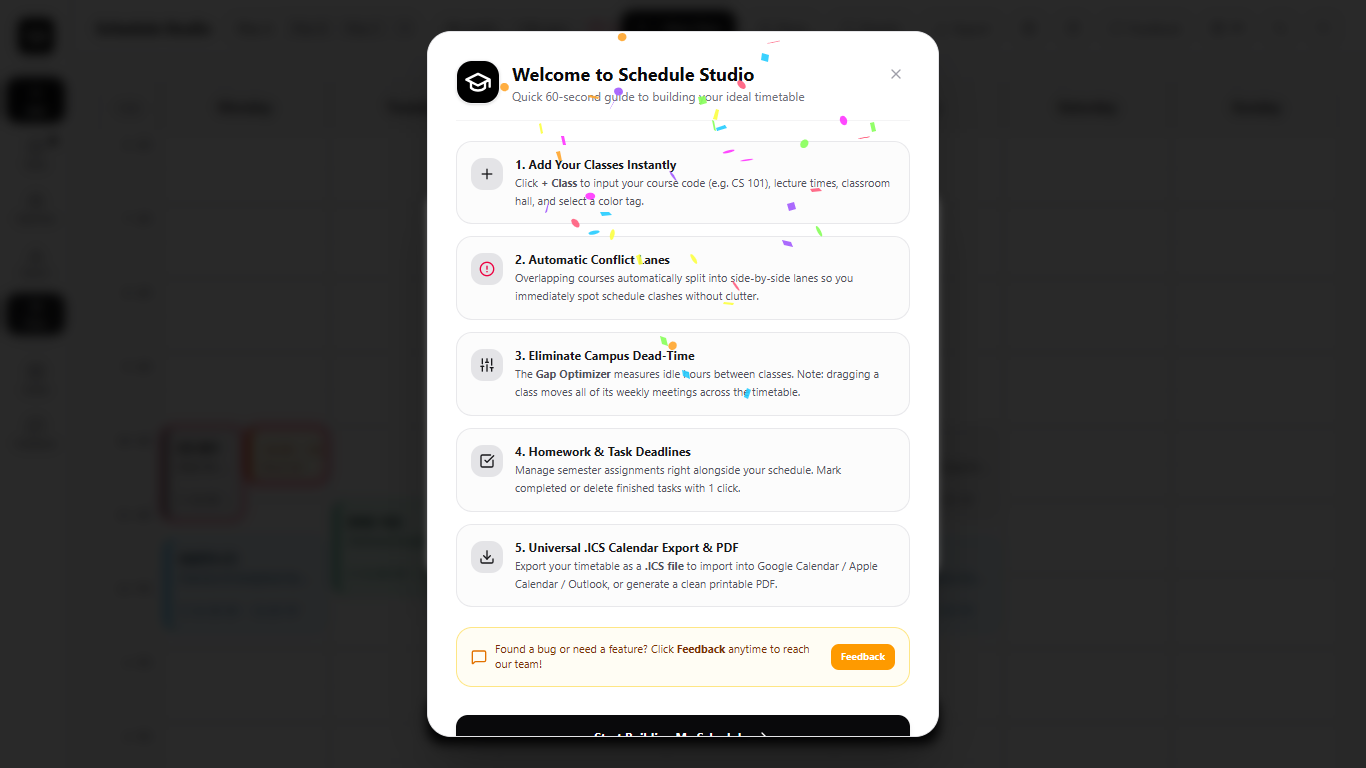
- Click “+ Add New Class” and plug in your prospective course times from your institution’s registration catalog.
- Review the “Total Credits” counter to ensure you stay between 14 and 16 credits.
- Click “Export Hub” to download your schedule as a smartphone lockscreen wallpaper or export an
.ICScalendar file for Google Calendar.
Your first semester sets the tone for your entire collegiate journey. Design your schedule with intention, protect your sleep, and give yourself room to thrive.
Ready to optimize your semester schedule?
Test combinations, eliminate gaps, and export to iCal in minutes.